

Some loads are too heavy, too long, or too awkward for a single crane to handle safely. A tandem lift solves that by using two or more cranes to raise and move one load together, which turns a routine pick into a coordinated engineering operation. This guide explains what a tandem lift is, how it differs from a standard lift, and why these jobs depend on careful planning and an accountable lifting partner.
Key Takeaways
- A tandem lift uses two or more cranes to lift a single load when one crane cannot handle the weight, length, or balance on its own. It is also called a multi-crane or dual crane lift.
- Every multi-crane lift is treated as a critical lift, which calls for a written lift plan prepared by a qualified person under consensus standards such as ASME P30.1.
- Organizations commonly define a critical lift as one that exceeds 75% of a crane’s rated capacity or that requires more than one crane, though no single industry-wide percentage applies.
- Multi-crane lifts succeed on coordination, not equipment alone. Load sharing, synchronized movement, ground conditions, and clear communication all have to align.
- Crawler cranes and all-terrain cranes are common tandem-lift choices, selected for their stability, capacity, and reach.
- Complex lifts are best handled by a single accountable partner, one team responsible for the engineering, rigging, equipment, and execution from start to finish.
What Is a Tandem Lift?
A tandem lift is a lifting operation in which two or more cranes raise and move a single load at the same time. Also called a multi-crane or dual crane lift, it is used when one crane cannot safely manage a load’s weight, length, or balance. The cranes share the load and must move in unison throughout the lift.
Tandem lifts are typically used in a few specific situations:
- Loads beyond a single crane’s capacity: weight exceeds what one available crane can lift within its safe working limits.
- Long or oversized loads: items such as bridge girders, vessels, or pipe sections that need support at two points to stay stable and avoid bending.
- Controlled rotation or upending: turning a load from horizontal to vertical, where two cranes manage the movement together.
- Constrained equipment access: site conditions that make two cranes more practical than positioning one very large machine.
Tandem Lift vs. Tailing a Load
A tandem lift and tailing a load are related but not the same. In a tandem lift, two or more cranes share the full weight of the load throughout the operation. In a tailing operation, one main crane carries most of the load while a second tailing crane supports and guides one end, usually to upend a long load into a vertical position.
See a tandem lift in action. In the video below, two Maxim cranes place the Pathfinder space shuttle replica at the U.S. Space and Rocket Center in Huntsville, Alabama. With one end of the fuselage near 140,000 pounds and the other around 77,000 pounds, the uneven load called for two machines lifting in coordination rather than a single crane, exactly the shared-load principle described above.
When Do You Need a Tandem Lift?
You need a tandem lift when a single crane cannot safely lift, balance, or position a load on its own. That usually comes down to one of three factors: the load is heavier than any available single crane’s safe capacity, it is too long to lift from one point without bending or swinging, or it has to be rotated or set in a way one crane cannot control.
Capacity is rarely a single number. A crane’s rated capacity changes with radius, boom configuration, and ground conditions, which is why a thorough crane lifting capacity assessment often determines whether a job needs one crane or several.
Standard Lift vs. Critical Lift: How Lifts Are Classified
Lifts are generally classified as either standard or critical, and that distinction drives how much planning a job requires. The consensus standard for this is ASME P30.1, which sets the criteria for categorizing a load-handling activity and the documentation required before it begins. A critical lift carries higher risk and demands a formal, written plan.
Organizations commonly define a critical lift as one that exceeds 75% of a crane’s rated capacity or that requires more than one crane, a benchmark used by bodies such as the U.S. Army Corps of Engineers. There is no single industry-wide percentage, so the exact trigger can vary by organization and project. What is consistent is that a multi-crane lift is treated as critical by default. The moment a second crane joins the pick, the job is in critical-lift territory.
The practical differences between the two come down to risk, equipment, and planning:
| Factor | Standard lift | Critical lift |
| Risk profile | Routine, within normal limits | Elevated risk to people, equipment, or the load |
| Cranes involved | A single crane | Often more than one crane; every multi-crane lift is critical by default |
| Capacity usage | Well within the crane’s rated capacity | A high share of rated capacity, or any multi-crane pick |
| Planning | Standard pre-lift checks | A written, engineered lift plan prepared by a qualified person |
Because a tandem lift is automatically a critical lift, it carries planning and engineering requirements well beyond the pre-lift planning on a routine single-crane job.
What Goes Into Coordinating a Multi-Crane Lift
Coordinating a multi-crane lift comes down to making two or more independent machines act as one system. That requires engineered planning for how the load is shared, how the cranes move in sync, how the ground supports them, and how the crew communicates. Each factor compounds the others, which is what makes these lifts so demanding.
Several interlocking factors define a coordinated lift:
- Load sharing and distribution: The load’s weight has to be divided correctly between the cranes, accounting for its center of gravity and rigging geometry. Multiple-crane lifts require a qualified person to prepare a lift plan that addresses load sharing and synchronization between the machines.
- Synchronization of movement: The cranes must hoist, swing, and travel together so the load stays level and within each machine’s limits. Any mismatch shifts weight unexpectedly onto one crane.
- Ground and site conditions: Each crane needs stable, engineered ground support, and the site has to accommodate the footprint, counterweights, and swing paths of multiple machines at once.
- Communication and signaling: A single lift director coordinates every operator so the cranes respond as one unit. Clear, real-time communication is what keeps the lift controlled.
- The engineered lift plan: All of this is captured in a written plan covering equipment selection, rigging, load calculations, and sequencing before anything leaves the ground.


Federal rules set the baseline. OSHA’s construction crane standard governs how cranes are operated on jobsites, but it defers the mechanics of complex multi-crane lifts to industry consensus standards like those from ASME. The detailed engineering lives in those standards and in the project’s own plan, where the same constraint mapping behind urban crane lift planning is multiplied across every machine on site.
The Cranes Behind Tandem Lifts: Crawler and All-Terrain Models
Tandem lifts most often rely on crawler cranes and all-terrain cranes, two machine types suited to heavy, coordinated picks. Crawler cranes provide stability and high capacity on a tracked base for sustained lifts, while all-terrain cranes combine highway mobility with strong lifting performance, making them practical to move between sites and position quickly.
The two machine types bring different strengths to a coordinated lift:
- Crawler cranes: Mounted on tracks for stability and maneuverability on prepared ground, a crawler crane is a common choice when a lift demands sustained capacity and a steady base.
- All-terrain cranes: Built to drive on highways and then lift on site, an all-terrain crane brings versatility across multiple jobsites and quick setup to coordinated picks.
All-terrain cranes are part of what the industry calls the mobile fleet: over-the-road machines that can be driven to the jobsite, each defined by its tonnage rating. Crawler cranes, by contrast, are transported in components and assembled on site. Maxim Crane offers a large, versatile fleet of both for rental with or without operating crews, and published load charts let project teams match a crane’s rated capacity to a specific pick.
Why Complex Lifts Call for a Single Accountable Partner
Because a tandem lift combines engineering, rigging, multiple machines, and tight coordination, the biggest risk is fragmentation: separate vendors for the cranes, the rigging, and the planning, with no one accountable for how they fit together. A single partner that manages the entire lift removes that gap and keeps one team responsible from assessment through execution.
That end-to-end model is built into how Maxim Crane approaches complex work:
- Engineering and planning: In-house crane engineering services cover lift planning, site evaluations, and the load calculations behind a critical lift, carried out by knowledgeable engineering staff.
- Engineered rigging: custom engineered rigging solutions, including gantry and jack-and-slide systems, for loads that standard rigging cannot handle.
- Project management: full-cycle project management from initial assessment through execution, so the lift runs as one coordinated plan.
- Operated and maintained rentals: Operated and maintained rentals supply equipment with experienced operators, reinforcing the single-accountable-partner model.
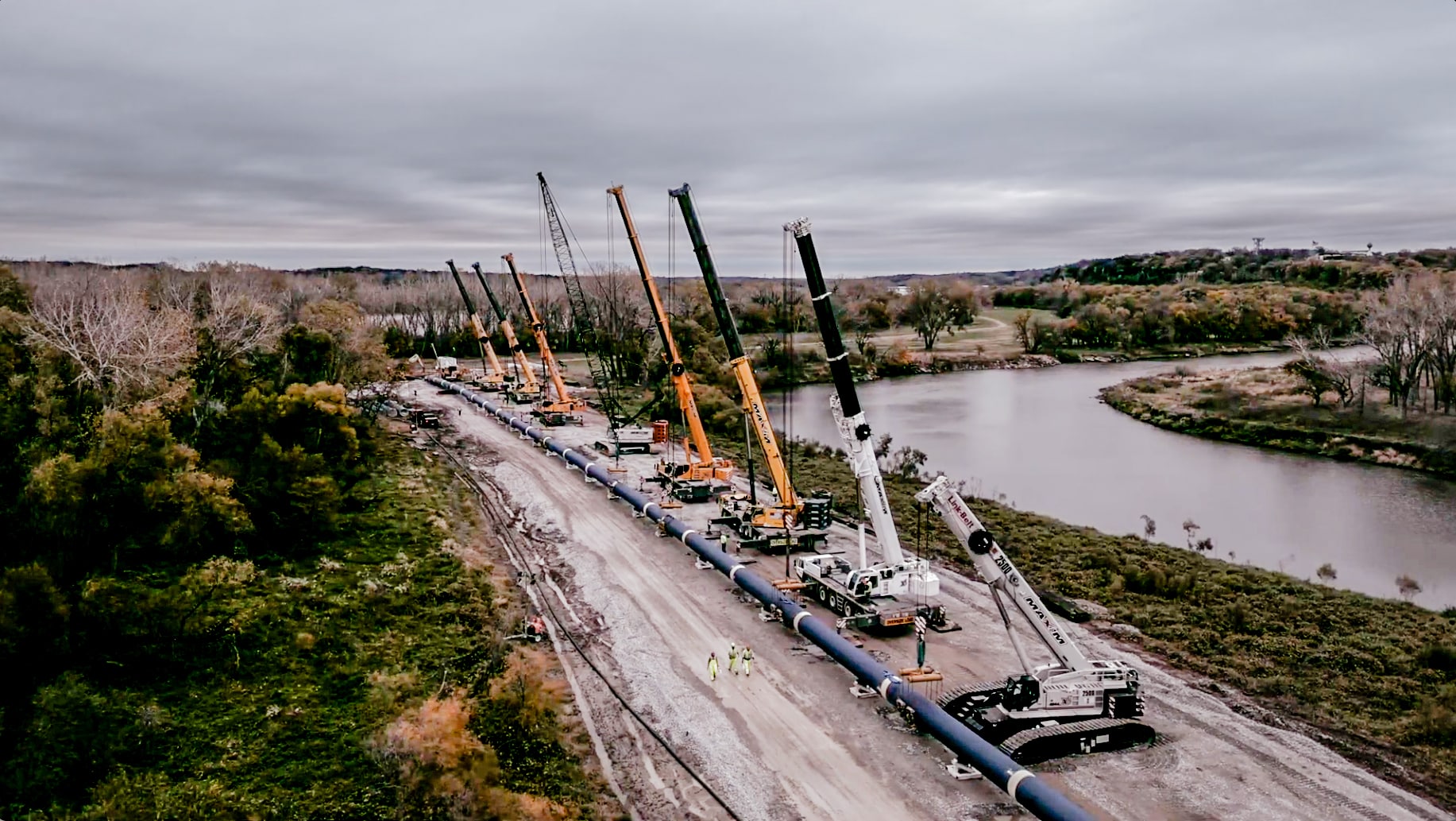
The scale of coordinated lifting is clear in projects like the Platte River water transmission line, where eight Maxim cranes worked simultaneously to lift a 288-ton pipeline section and guide it beneath the river.
Maxim Crane’s single-point-of-contact approach shows up across its customer relationships. In describing its one-stop-shop partnership with Maxim Crane, Layton Construction put the value of a single accountable partner plainly: “It’s a one call deal and the job is done. I get the equipment I need. They know what I need and they take care of me.”
That model is backed by scale and credentials. As one of the largest providers of crane rental and comprehensive lifting services in the country, with ISO 9001, ISO 14001, and ISO 45001 certifications and a zero accident safety philosophy, Maxim brings knowledgeable engineering staff and coast-to-coast coverage to coordinated lifts.
Frequently Asked Questions About Tandem Lifts
What is considered a tandem lift?
A tandem lift is any lift in which two or more cranes raise and move the same load together. It is also called a multi-crane or dual crane lift. The defining feature is that the cranes share one load and operate in coordination, rather than each handling a separate item.
Is a critical lift plan required by law?
There is no single federal rule that mandates a document called a “critical lift plan” for every job. OSHA’s construction crane standard sets baseline operating requirements and defers complex multi-crane mechanics to industry consensus standards. In practice, critical lifts, including all multi-crane lifts, are planned to those standards and to each project’s safety requirements, so a written, engineered plan is the norm for this work.
What is the definition of a critical lift?
A critical lift is a lift that carries elevated risk and therefore requires formal planning. Organizations commonly define one as a lift that exceeds 75% of the crane’s rated capacity or that involves more than one crane, a benchmark used by bodies such as the U.S. Army Corps of Engineers. Because thresholds vary by organization, the classification is set during planning rather than by a single universal number.
What are the parts of a critical lift plan?
A critical lift plan documents everything needed to carry out a high-risk lift safely, but building one is specialized engineering work, not a fill-in-the-blank form. It generally addresses equipment selection, load weight and center of gravity, rigging, ground and site conditions, and the lift sequence. On a multi-crane lift, the analysis grows more complex because the load is shared between machines.
How do you calculate crane capacity for a critical lift?
Crane capacity for a critical lift is determined by engineering analysis, not a simple formula, because rated capacity changes with radius, boom configuration, ground conditions, and rigging. For a multi-crane lift, planners also account for how the load is shared between machines as they move. This is why it is worked out by knowledgeable engineering staff using detailed load charts, not estimated on site.
Plan Your Next Tandem Lift With Maxim Crane
A tandem lift is only as strong as the planning and coordination behind it. If your project involves a load that may need more than one crane, the surest path is a partner that handles the engineering, equipment, and execution as one. Request a quote from Maxim Crane to discuss your lift, or explore the full fleet of rental cranes to find the right equipment for the job.
