

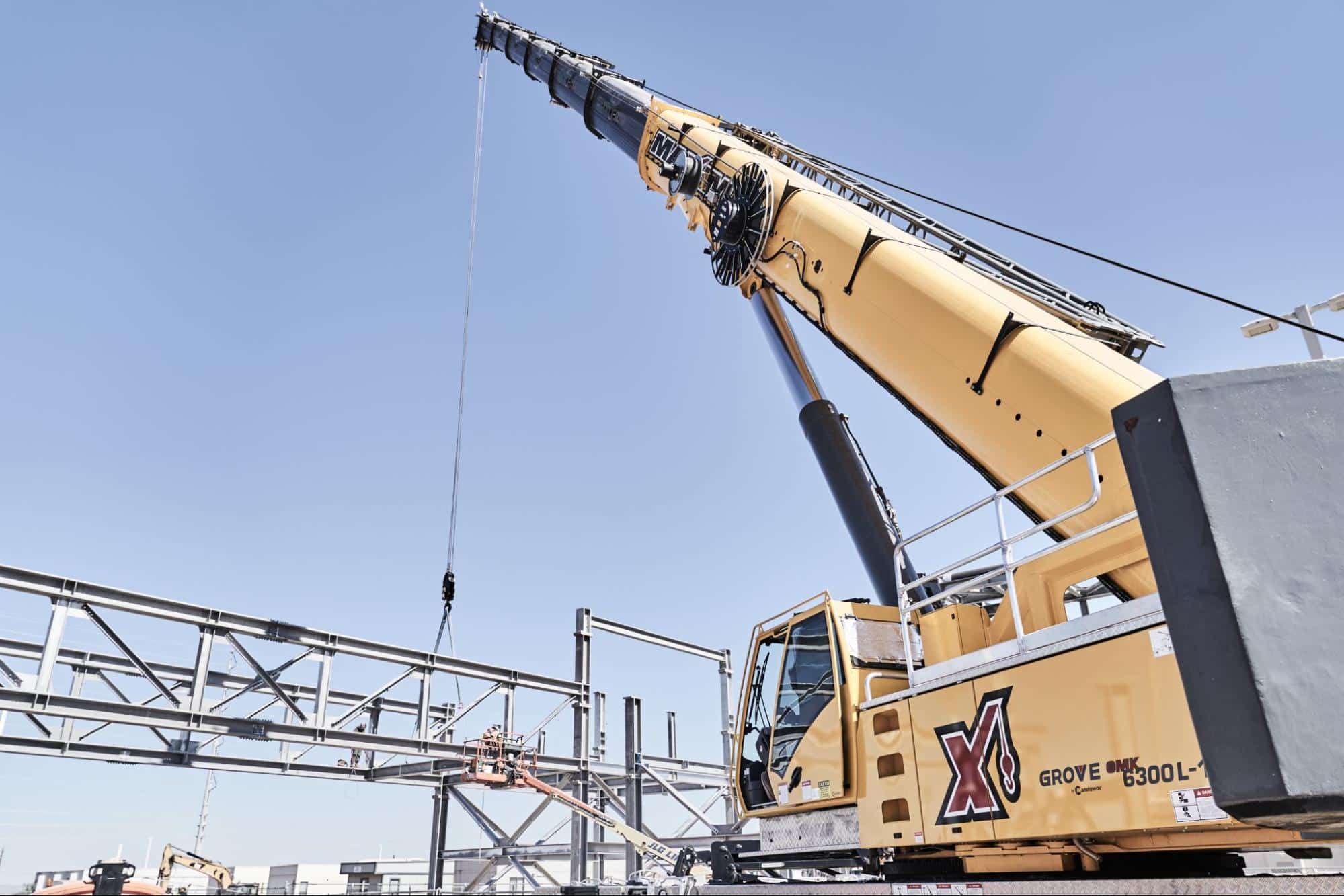
Data center construction moves fast, runs large, and carries schedule pressure that standard commercial builds rarely match. Choosing the right crane services for data center construction is less about equipment availability and more about aligning lifting strategy with a mission-critical delivery schedule. This guide covers the lifting scope across a data center build, how crane selection shifts by phase, and why site logistics can make or break the timeline.
Key Takeaways
- Data center builds are multi-phase projects where crane scope spans site preparation, structural shell erection, MEP installation, generator set placement, and rooftop equipment commissioning.
- More than 35 GW of data center capacity is under construction in North America, with 92% of that capacity precommitted to hyperscale and enterprise tenants.
- Crane type selection is phase-driven: crawler cranes for heavy structural steel, all-terrain cranes for mechanical and precast lifts, tower cranes for constrained or vertical sites, and boom trucks for commissioning work.
- Lifting strategy directly affects schedule certainty on mission-critical builds. A poorly sequenced lift plan can stall structural progress, delay MEP rough-in, or push commissioning dates.
- Hyperscale developers and large colo operators increasingly standardize crane partners across multi-site programs through national accounts structures, which consolidate engineering and operational consistency.
- Maxim Crane Works provides comprehensive lifting services coast-to-coast, with engineered rigging, project management, and operated and maintained rental support for data center GCs and owners.
Why Data Center Construction Is Different From Standard Commercial Builds
Data center projects combine the mechanical complexity of industrial facilities with hyperscale-driven timelines that few other commercial construction programs face. The result is a build profile where lifting scope is heavier, sequencing is tighter, and schedule slippage carries real financial weight because capacity is often already leased before the building is watertight.
The volume of capacity being built underscores the pace. More than 35 GW of data center capacity is under construction in North America, with 92% precommitted through binding lease agreements or owner-occupied development, and vacancy holding at 1% for a second consecutive year. Primary markets also posted record net absorption of 2,497.6 MW in 2025, outpacing the prior 2024 record of 1,809.5 MW, with 5,994.4 MW still under construction at year-end.
A few characteristics separate these builds from conventional commercial construction:
- Mechanical weight and density. Generator sets, chiller plants, cooling towers, and switchgear often arrive as prefabricated modules that push single-lift weights well beyond typical office or retail scope.
- Power infrastructure governs the critical path. Substation work, on-site generation, and utility tie-ins frequently drive the schedule more than building envelope progress, and crane involvement follows the power schedule as much as the structural schedule.
- Precommitted revenue creates schedule pressure. When capacity is leased before construction completes, every week of delay has a dollar cost that shows up in the owner’s pro forma.
- Geography keeps shifting. The 2025 Global Data Center Market Comparison evaluates 97 global markets across 20 variables, including power availability, and inland power-available markets like Phoenix have moved up the rankings as tenants chase available capacity.
Equipment availability is baseline. Schedule alignment, engineered support, and logistical coordination are what actually protect the delivery date.
How Lifting Needs Change Across Data Center Construction Phases
Crane scope on a data center build is not a single deployment. It evolves across four broad phases, and the equipment in the laydown yard should evolve with it. A crane partner that understands multi-phase project planning can sequence equipment rotations so the right machine is on site for each phase without overbooking capacity during slower stretches.


Site Preparation and Civil Work
Site prep is typically light on crane scope but heavy on coordination. Early involvement includes utility work, precast manhole and vault setting, light structural steel for screening walls or temporary structures, and occasional precast foundation elements. Mobile fleet equipment (boom trucks, hydraulic truck cranes, and all-terrain cranes) covers most of this phase, deploying quickly and repositioning easily while earthwork and utility trades cycle through.
Structural Shell Erection
Structural steel and tilt-up or precast panel work are where crane scope scales up. Most data center shells are wide, low-rise, and steel-framed, with long-reach structural picks across a large footprint. Crawler cranes are the common choice for structural erection on these sites because of their stability, reach, and ability to work through a full picking radius without outrigger repositioning. On sites with limited laydown area or adjacent vertical construction, tower cranes may be the right answer instead.
MEP Installation and Generator Set Placement
This is the crane-intensive middle phase of most data center builds. Generator sets, chiller skids, air-handling units, transformer modules, and prefabricated electrical rooms all require placement by crane, often through roof openings or into tight mechanical yards. All-terrain cranes handle most of this scope because they combine road mobility with the capacity and reach needed for mechanical placement. Engineered rigging services come into play when modules are awkward, asymmetric, or require multi-point attachment to hold the intended orientation during the lift.
Rooftop Equipment and Commissioning
Late-stage lifts include rooftop condensers, smaller mechanical units, antenna and telecom equipment, and remedial placements identified during commissioning. Boom trucks and hydraulic truck cranes usually cover this phase because they deploy faster, require less laydown area, and suit shorter-duration service lifts. Commissioning typically continues after building turnover, so rental cycles in this phase are often intermittent rather than continuous.
How Lifting Strategy Affects Data Center Schedule Certainty
Lifting strategy affects schedule certainty because crane availability, lift sequencing, and engineered lift planning sit on the critical path for most data center phases. A well-sequenced lift plan keeps trades flowing, prevents idle days, and gives the GC enough lead time to land rooftop mechanical equipment before the building is fully enclosed.
Three planning decisions carry the most weight:
- When engineered lift planning happens. Heavy generator sets, prefabricated electrical rooms, and large chiller modules require engineered lift plans that account for load weight, rigging geometry, ground bearing pressure, and crane stability on the chosen pad. Pulling engineering into the project earlier gives the lift plan room to inform site layout, not the other way around.
- How crane rotations align with trade sequencing. Leaving a structural crawler crane on site past its useful phase consumes laydown area that MEP trades need. Rotating in the wrong mobile crane for a heavy mechanical pick forces a re-pick with a larger machine, which usually means a day of lost work. A crane provider that plans phase-by-phase rotations reduces both problems.
- Whether the crane partner brings operated and maintained capability. Most data center GCs rely on operated and maintained rentals for mission-critical phases because the operator and oiler are integrated into the lift plan from the start, not sourced separately.
Data center builds are not the right place for crane sourcing to be treated as a commodity decision. The machine matters. The crew matters. The planning matters more than either.
Site Logistics on Data Center Jobsites
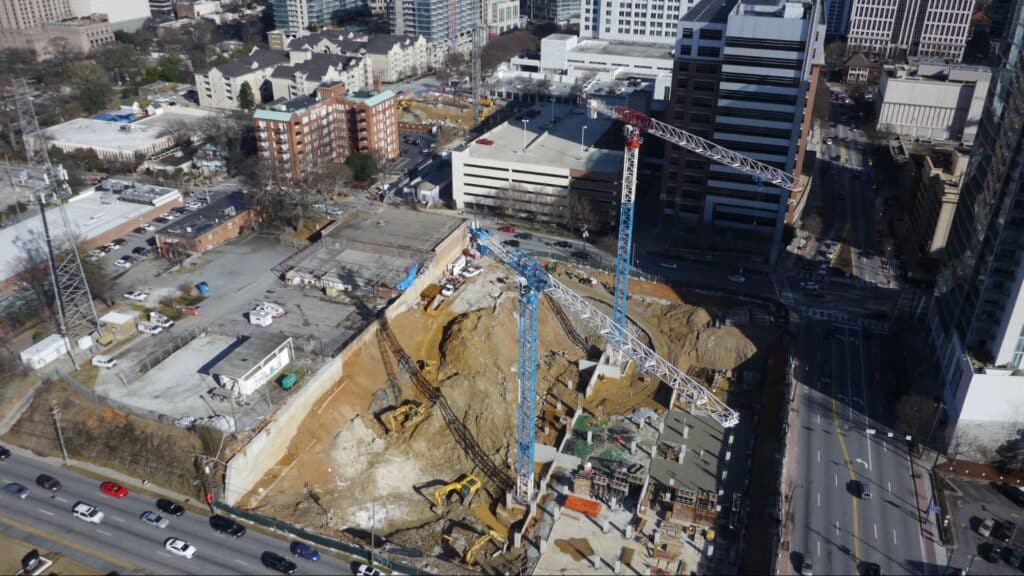
Site logistics on a data center jobsite are dominated by three constraints: access, laydown, and sequencing around MEP deliveries. Wide single-story footprints look generous from above, but access roads, utility tie-ins, security fencing, and live-power zones leave less usable space than the plan suggests. On constrained or brownfield sites, lift planning in tight site conditions becomes central to the crane scope rather than a late consideration.
Crews on these jobs routinely coordinate with MEP contractors on delivery windows, generator and chiller set arrivals, and crane pad preparation. Miscoordination between equipment deliveries and crane availability is a common source of schedule slippage on data center builds, and one of the most easily prevented when the lifting partner is in logistics planning early.
Supporting Multi-Site Data Center Programs Through National Accounts
Hyperscale owners and large colo developers rarely build one data center. They build programs, sometimes a dozen or more sites across multiple states, often running in parallel. Standardizing the lifting partner across those sites solves several problems at once: consistent operational practices, consistent engineering and lift planning standards, and a single point of accountability for rental scheduling.
Maxim Crane’s National Accounts Program is built for that exact use case. It gives multi-site developers a centralized partnership with a provider that operates more than 50 locations across five regions.
The certifications stack covers quality (ISO 9001), environmental (ISO 14001), and occupational health and safety (ISO 45001) management. A zero accident safety philosophy underpins all of it, and the hyperscale community treats that combination as table stakes. The program’s structure is designed for the procurement and coordination realities of multi-site builds.
For GCs and program managers running concurrent builds in different markets, that consolidation reduces procurement overhead and delivers a partner whose process does not change from site to site.
Frequently Asked Questions About Crane Services for Data Center Construction
What crane types are used in data center construction?
Most data center builds use a mix of crawler cranes for structural steel erection, all-terrain cranes for mechanical and generator set placement, and boom trucks or hydraulic truck cranes for rooftop and commissioning lifts. Tower cranes come into play on constrained or vertical sites. The right mix depends on the site footprint, the structural system, and how dense the mechanical scope is.
When do data center projects need tower cranes versus mobile cranes?
Tower cranes are typically used on multi-story data center builds, dense urban sites, or projects where laydown area is too tight for a crawler or mobile crane. Mobile fleet equipment (all-terrain cranes, hydraulic truck cranes, and boom trucks) covers most lifts on single-story hyperscale sites because it deploys faster and repositions more easily across a large footprint.
How does lifting strategy affect the data center construction schedule?
Lifting strategy sits on the critical path for structural erection, generator and chiller placement, and commissioning. When engineered lift planning is done early, crane rotations can align with trade sequencing and mechanical deliveries, which protects the schedule. When it is done late or treated as a commodity decision, schedule slippage tends to compound across phases.
What is a national accounts program for crane rental, and why does it matter for data center builds?
A national accounts program consolidates crane rental and lifting services under a single provider across multiple project sites, with standardized operational, engineering, and procurement processes. For hyperscale and colo developers running concurrent builds, it reduces procurement overhead, keeps lift planning consistent, and gives program managers a single accountable partner across regions.
How do data center site logistics differ from a commercial office build?
Data center sites carry heavier mechanical lifts, denser generator and switchgear placements, and tighter coordination between MEP deliveries and crane availability than most commercial office builds. Access, laydown constraints, and live-power zones often leave less usable site space than the plan suggests, which makes early coordination between the lifting partner and MEP contractors more consequential than on a typical office project.
Plan Your Data Center Lifting Scope With Maxim Crane
Looking for a lifting partner for a single data center build or a multi-site program? Request a quote from Maxim Crane or explore the National Accounts Program to discuss how Maxim supports mission-critical construction across North America.
