

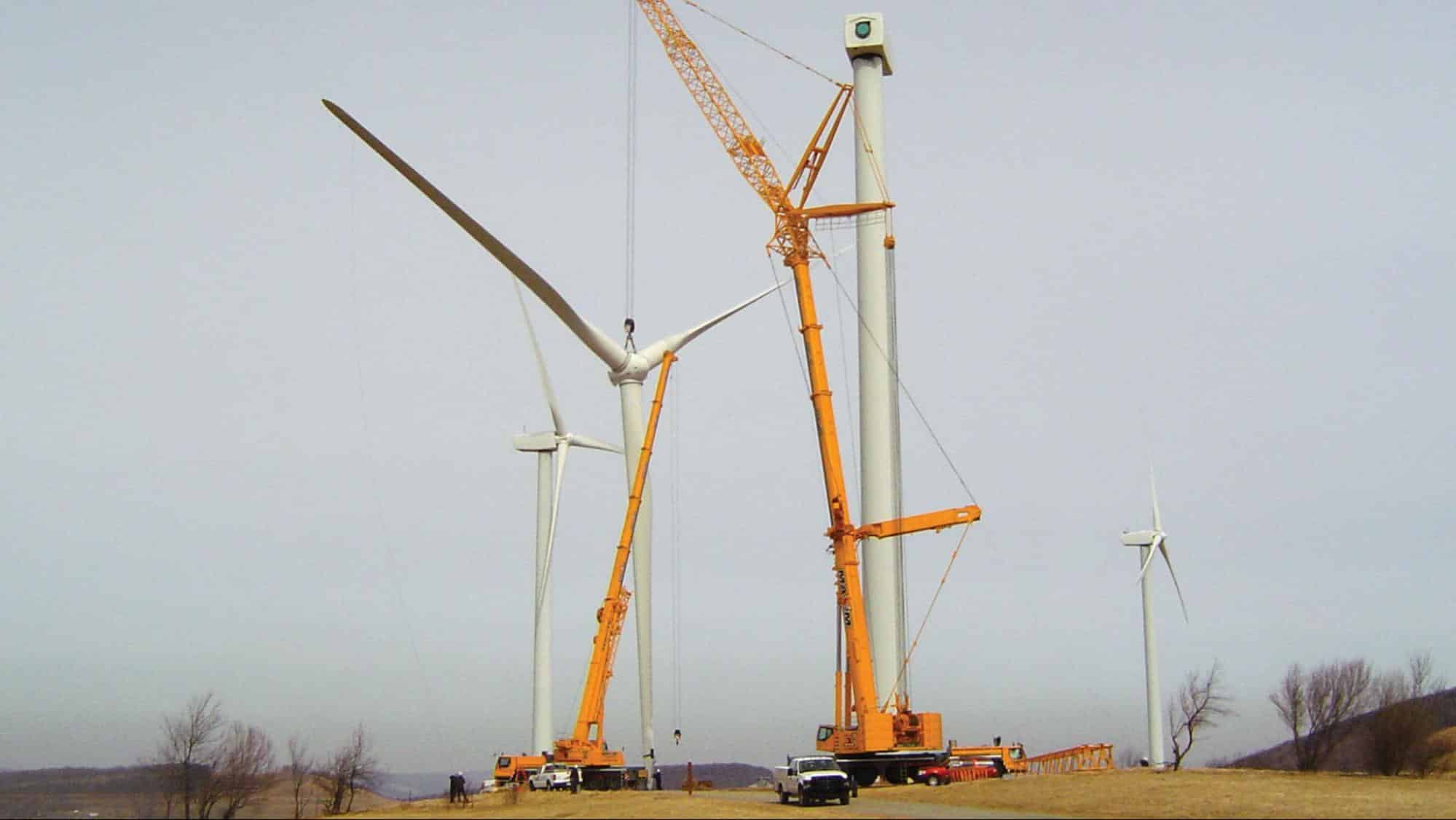
Wind energy construction is accelerating across the United States, and every turbine erected depends on having the right crane at the right site. Whether your team is planning a greenfield wind farm, a repowering project, or scheduled turbine maintenance, wind energy crane rental requires a different level of planning than standard construction lifts. This guide covers the crane types, site challenges, and logistics that wind energy contractors and EPC teams need to evaluate when choosing a crane rental partner.
Key Takeaways
- The U.S. added more than 7 GW of new wind capacity in 2025, a 36% year-over-year increase, with 46 GW forecast through 2029. That growth translates directly into rising demand for crane rental across installation, repowering, and maintenance projects.
- Crawler cranes handle the heaviest wind energy lifts, including nacelle placement on 3 MW+ turbines that can require 330+ tons of lifting capacity. All-terrain cranes support component handling, blade replacement, and mobilization between turbine pads.
- Wind farm crane operations differ from standard construction due to remote site access, soft or variable ground conditions, wind-dependent lift scheduling, and the logistical challenge of transporting oversized components like blades and tower sections.
- Repowering older wind farms with larger, more efficient turbines is a growing segment of the market, requiring the same crane fleet as new construction but with tighter site constraints from existing infrastructure.
- A coast-to-coast crane rental provider with engineering services, operated and maintained rentals, and heavy hauling capabilities can serve as a single partner across multiple wind farm locations.
Why Wind Energy Is Driving Crane Demand
U.S. wind power is on a steep growth trajectory, and that expansion is creating sustained demand for crane rental for wind farms. Wind turbines generated 10.3% of U.S. electricity in 2025, while wind and solar combined hit a record 17% of total generation that same year.
The near-term pipeline is even larger. The U.S. added more than 7 GW of new wind capacity in 2025 (a 36% increase over the prior year), and Wood Mackenzie and the American Clean Power Association project 46 GW of additional capacity through 2029, with 2026 and 2027 expected to be the strongest years at 10.7 GW and 12.7 GW respectively.
The demand outlook is driven by a structural shift in U.S. power consumption. After a decade of flat demand, utilities have committed to 160 GW of large-load additions, according to Wood Mackenzie Director of Research Leila Garcia da Fonseca. Projected power demand growth of roughly 3% annually through 2029 (compared to 0.7% over the prior decade) positions wind as a strong fit for rising baseload needs, with data center construction alone accounting for approximately 59 GW of total peak demand growth.
For contractors and EPC teams, the growth trajectory is clear: more turbines going up and older ones coming down for repowering means sustained demand for crane rental partners with national reach.
Crane Types Used in Wind Energy Projects
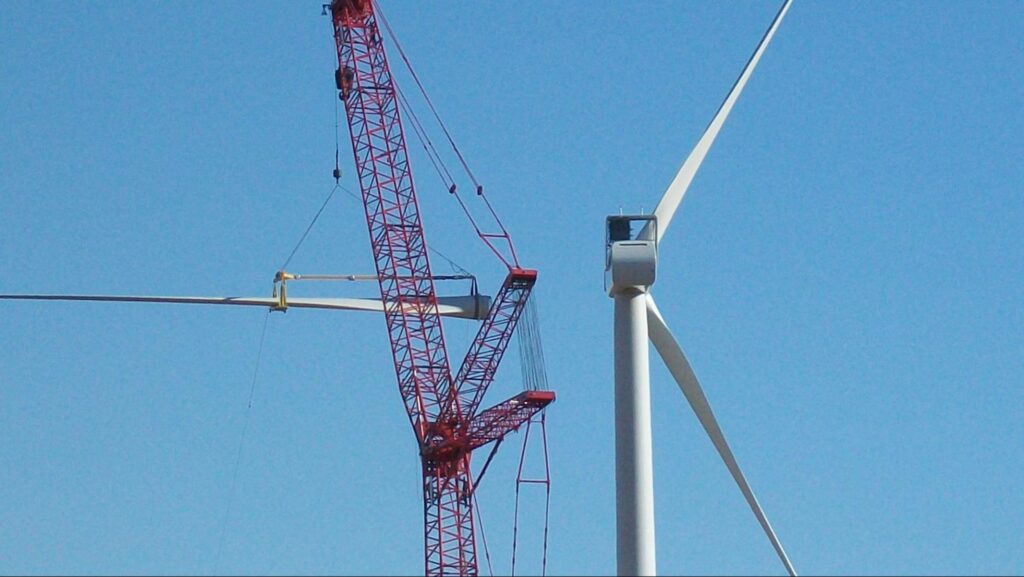
Two crane categories carry the majority of wind farm construction and maintenance work: crawler cranes and all-terrain cranes. Each fills a distinct role based on lift requirements, site conditions, and mobility needs.
Crawler Cranes for Nacelle and Rotor Assembly
Crawler cranes are the primary equipment for the heaviest lifts on a wind farm. Nacelles are the single heaviest turbine component, and on 3 MW and larger turbines, placing the nacelle at hub height often requires a crawler with 330+ tons of lifting capacity. Rotor assemblies, blade placement, and upper tower section erection also fall to crawlers when weights and heights exceed all-terrain crane limits.
Their track-mounted undercarriage provides stability on the soft or uneven ground conditions common to wind farm sites. Crawlers can also reposition between turbine pads without full disassembly, reducing downtime on multi-turbine projects. Our guide to crawler cranes covers how these machines handle heavy-duty construction work across industries. Maxim Crane offers a full range of crawler cranes to match the lifting requirements of any wind energy project.
All-Terrain Cranes for Support Lifts and Mobilization
All-terrain cranes fill a complementary role on wind energy projects. Their ability to drive on public highways and then operate on rough jobsite terrain makes them well suited for moving between turbine locations across a large wind farm footprint without requiring a lowboy trailer.
Common wind energy applications for all-terrain cranes include:
- Lower tower section assembly and component unloading at staging areas
- Gearbox replacement and blade swaps during scheduled maintenance
- Assist crane duties during nacelle and rotor lifts led by a larger crawler
Maxim Crane’s all-terrain fleet covers a wide range of capacities. Maxim’s guide to all-terrain cranes covers the versatility of these machines across industries, including renewable energy and wind turbine erection.
What Makes Wind Farm Crane Operations Different
Wind projects introduce a set of operational variables that standard construction lifts rarely face. Remote locations, weather-dependent scheduling, and multi-turbine mobilization across wide geographic footprints all require careful planning from both the contractor and the crane rental provider.


Remote Sites and Ground Conditions
Wind farms are typically sited on ridgelines, open plains, and other elevated terrain where consistent wind resources exist. These locations are often far from urban infrastructure, which creates logistical challenges at every stage of the project.
Key site considerations that affect crane operations include:
- Access roads may need to be built or reinforced to support the weight of crane components during transport and mobilization.
- Ground bearing capacity at each turbine pad must be assessed to ensure crawler cranes can set up safely without sinking or shifting.
- Turbine blades, which can exceed 200 feet in length, require specialized heavy hauling and route planning to reach remote sites.
Wind Windows and Lift Scheduling
Wind speeds at hub height are significantly higher than at ground level due to a phenomenon called wind shear. A calm day at ground level does not guarantee safe lifting conditions at 80 or 100 meters, which means crane operators must rely on real-time anemometer readings and observe defined wind speed thresholds before proceeding with a lift.
This is especially critical during nacelle placement and blade installation. Blades and nacelle housings have large surface areas that act as sails during a lift, making them highly sensitive to gusts. Projects that depend on hitting narrow weather windows require experienced operators and detailed engineering and lift planning to minimize weather-related delays.
Wind Turbine Repowering: A Growing Application for Crane Rental
Repowering involves replacing older turbine components, or in some cases entire turbines, with larger and more efficient units. As first-generation wind farms in the U.S. reach the end of their initial design life, repowering is becoming a significant share of wind turbine crane services demand alongside new construction.
Repowering projects share the same crane requirements as new installation: crawler cranes for nacelle lifts, all-terrain cranes for component handling, and heavy hauling for transporting new blades and tower sections. However, they also introduce additional complexity:
- Existing turbine infrastructure constrains crane positioning and access routes, often requiring more precise lift planning than a greenfield site.
- Older components must be dismantled and removed before new equipment can be installed, which doubles the number of critical lifts per turbine.
- Upgraded turbines are often taller and heavier than the originals, potentially requiring higher-capacity cranes than were used during initial construction.
Why a National Crane Rental Partner Matters for Wind Projects
Wind farms are built across wide geographic footprints. A single developer may have active projects in the Great Plains, the Southwest, and the Northeast simultaneously. Consolidating crane rental under a coast-to-coast provider reduces coordination overhead and mobilization costs compared to managing multiple regional operators.
Maxim Crane’s capabilities align with the specific demands of wind energy projects in several ways:
- 50+ locations across five U.S. regions, providing the geographic reach to stage equipment closer to remote wind farm sites and reduce mobilization time.
- Operated and maintained rentals with access to a network of 2,000+ operators. Wind projects in remote areas often cannot source qualified crane operators locally, making a provider-supplied crew a practical necessity.
- Engineering services for PE-stamped lift plans. Wind nacelle and blade lifts involve complex load calculations, wind exposure analysis, and ground condition assessments that require pre-engineering before any crane arrives on site.
- Heavy hauling capabilities for transporting oversized turbine components to remote locations, including blade transport that requires specialized trailers and route planning.
- ISO 9001, ISO 14001, and ISO 45001 certifications, 2024 SC&RA Crane & Rigging Group Safety Award, and a record-low Total Recordable Incident Rate (TRIR) in 2024. Wind energy work at height in remote conditions demands a partner with a demonstrated safety record and a zero accident safety philosophy.
Frequently Asked Questions About Wind Energy Crane Rental
What type of crane is used to install wind turbines?
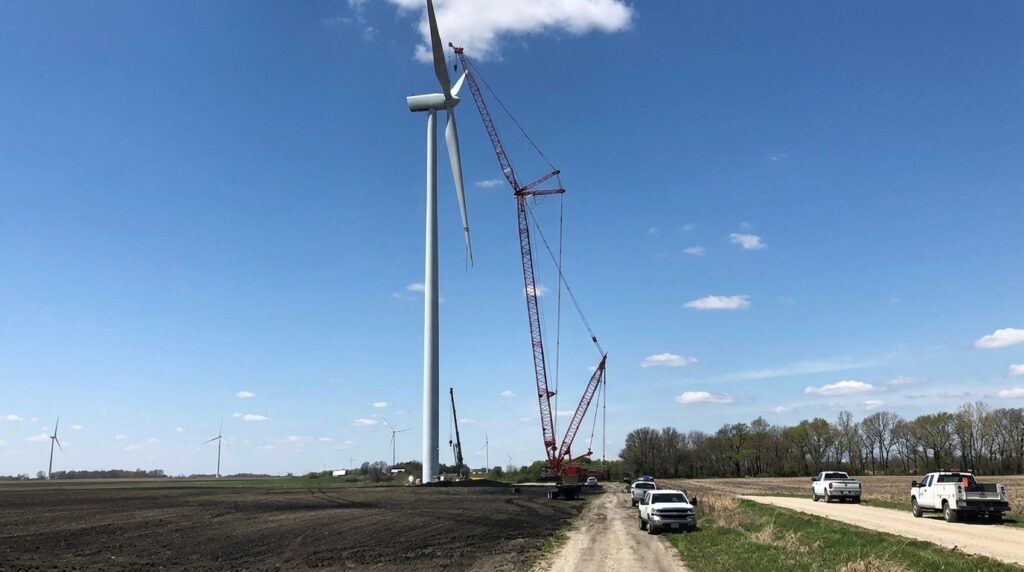
Crawler cranes are the primary crane type for wind turbine installation because they provide the lifting capacity and stability required for nacelle placement and rotor assembly at heights of 80 to 100+ meters. All-terrain cranes serve as support equipment for component handling, lower tower assembly, and mobilization between turbine pads. Most wind farm construction projects use both crane types simultaneously.
How do wind conditions affect crane operations during turbine installation?
Wind speeds at hub height are considerably higher than at ground level due to wind shear. Crane operators must use real-time anemometer data and follow defined wind speed limits before proceeding with a lift. Blades and nacelle housings have large surface areas that catch wind like sails, making these lifts especially sensitive to gusts. This means work schedules are built around available wind windows, and delays due to weather are common on wind projects.
What is the difference between wind turbine installation and repowering?
Installation refers to erecting new turbines on a greenfield or newly developed wind farm site. Repowering replaces aging turbine components (or entire units) with newer, more efficient equipment on an existing wind farm. Repowering uses the same types of cranes but involves additional steps: dismantling old components, navigating tighter site constraints from existing infrastructure, and often lifting heavier loads than the original installation required.
What size crane is needed to erect a wind turbine?
The crane size depends on the turbine model, hub height, and component weights. For 3 MW and larger turbines, nacelle lifts commonly require crawler cranes in the 330+ ton capacity range. Smaller turbines or component maintenance work may only need a 150- to 200-ton class machine. Maxim Crane’s crawler and all-terrain fleets provide options across the full range of wind energy applications.
Partner with Maxim Crane for Your Next Wind Energy Project
From crawler cranes for nacelle lifts to all-terrain cranes for blade replacement, Maxim Crane provides the fleet, the engineering support, and the national footprint to serve wind energy projects of any scale. With 50+ locations and the only coast-to-coast lifting services coverage in the U.S., Maxim Crane can put the right equipment at the right site, wherever your wind farm is located. Request a quote to discuss your project requirements.
